Designing car care around expert consultation

Project Overview
Ladipo is a car-care platform for Nigerian car owners, bringing automotive advice, car parts, and repair services into one experience.
I joined as the founding product designer, working with the founder and PM to define and prioritise the MVP.
What I led
I led the car-owner experience, from user interviews and journey mapping through to user flows and UI design.
I also contributed to the experiences for automotive experts, parts sellers, and workshops, since all three needed to work together for the service to function end to end.
The experience we designed
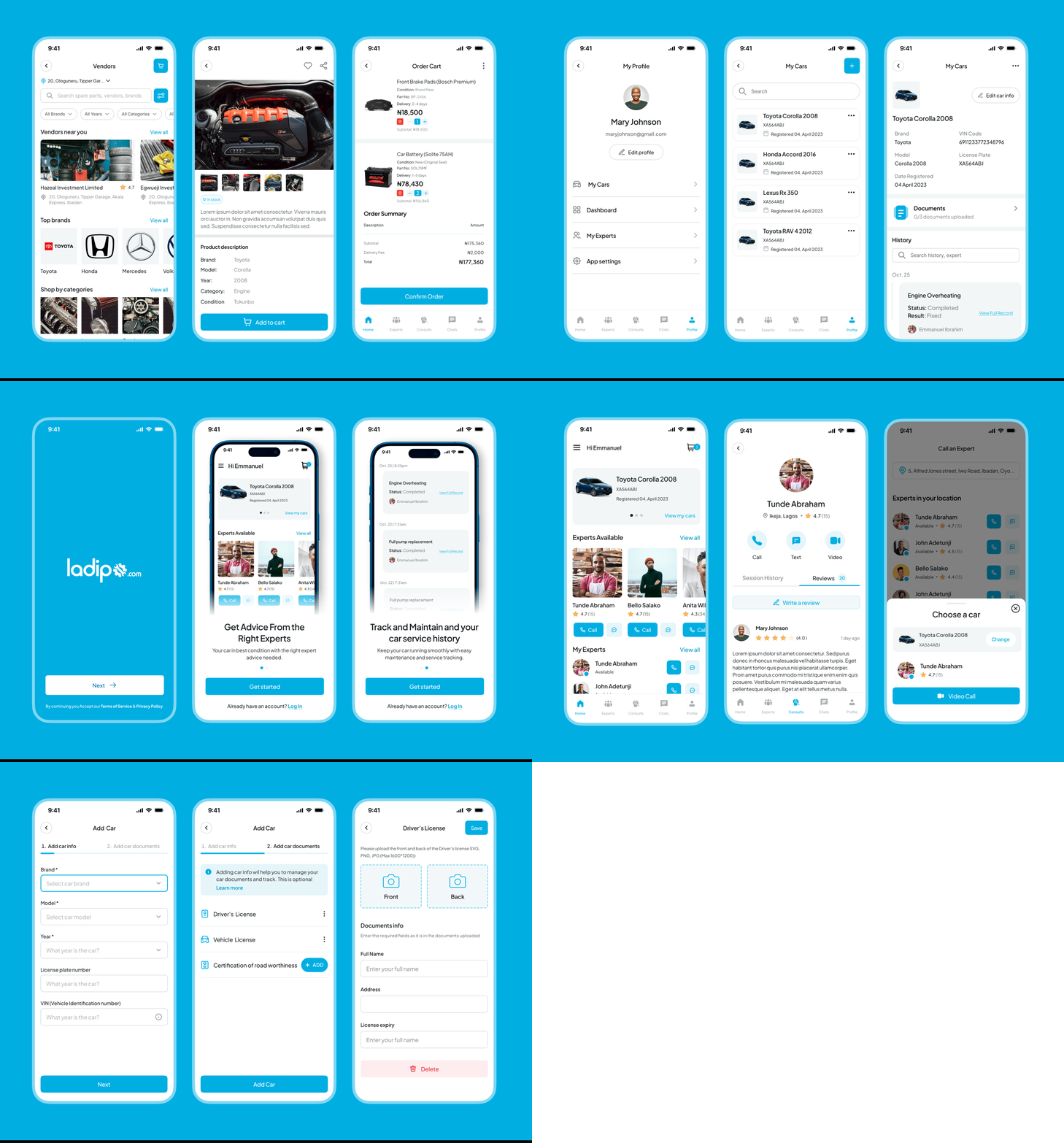
Ladipo brought expert advice, car parts, and repair services into one product.
Car owners could speak with automotive experts, shop for parts from vendors, connect with workshops for repairs, and keep a record of activity around their cars.
Car owners often needed help navigating car problems
We interviewed five car owners to understand what they did when something went wrong with their cars.
A recurring pattern was that owners often relied on other people to help them make decisions. They might need help understanding the problem, finding someone to repair it, or knowing where to buy a part.
Buying parts introduced its own difficulties, including uncertainty around sellers, prices, and whether they could trust what they were getting.
That gave us a broader problem to solve: helping owners move from uncertainty to the right kind of help.
Shaping the experience around the help owners needed
The research showed us that owners often needed assistance at different points, from understanding what was wrong to finding repairs or sourcing parts.
Rather than treating consultation, workshops, and vendors as separate services, we designed them to work as a connected journey. Expert guidance could help determine what an owner needed next, while owners who already knew what they needed could go directly to the relevant service.
Getting help from an automotive expert
Owners could find nearby experts, compare their profiles and ratings, choose the car they needed help with, and start a video, voice, or chat consultation.
Afterwards, the expert recorded the discussion and outcome against the car, giving the owner a history they could return to later.
From consultation to a workshop when repairs were needed
Some problems couldn’t be resolved through advice alone.
When an issue required hands-on repair, the expert could recommend a workshop. The owner could review the recommendation and continue from the consultation into getting the car repaired instead of having to begin another search on their own.

Helping owners find the right part when they needed one
A consultation could reveal that a replacement part was needed, in which case the expert could recommend a vendor.
Owners who already knew what they needed could also search for parts directly. Purchases stayed within Ladipo, with escrow adding more accountability to the transaction, and owners could choose how they wanted to receive the part.
Supporting car ownership beyond consultations and purchases
We did not want Ladipo to become useful only when something went wrong.
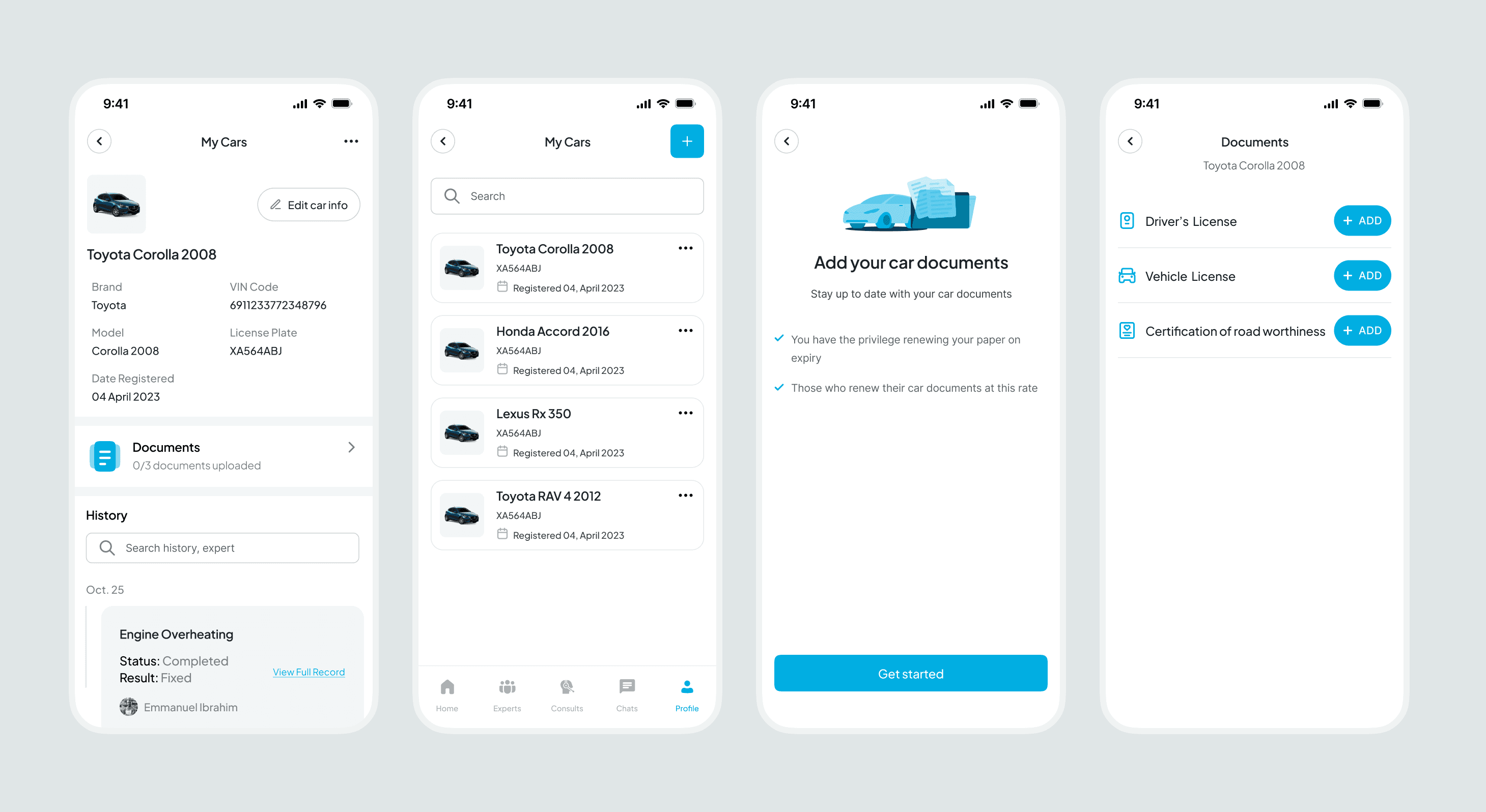
Owners could keep their vehicle information and important car documents in one place, access them when needed, and receive reminders when documents were approaching expiry.
We still kept vehicle setup optional so users could get help without completing it upfront. For owners who added their car, Ladipo could support ongoing car care as well as consultations, repairs, and purchases.

Designing for owners, experts, workshops, and vendors
The car-owner experience depended on what happened on the other side.
Experts needed to manage consultations and record outcomes. Workshops needed to receive owners who required repairs. Vendors needed to manage parts and orders.
We therefore could not design each experience in isolation. Decisions on one side affected what another user could do next, so I worked across those touchpoints while keeping the car-owner journey as the main reference point.


Reflection
The difficult was deciding how those experiences should connect while still keeping the journey understandable for the car owner.
Research gave us a strong reason to make consultation the starting point, but we did not yet have reliable conversion or retention data to validate the full model.
The next thing I would want to understand is whether consultations consistently help owners reach the right next step, and whether those downstream actions create enough value for both users and the business.